Repeat an Outfit and Change One Detail: Learn What Actually Matters
Repeating a successful outfit is a useful way to understand it. Change one detail, such as shoes, a tuck or a small accessory, and compare the result. A controlled experiment can reveal more than replacing several garments at once.
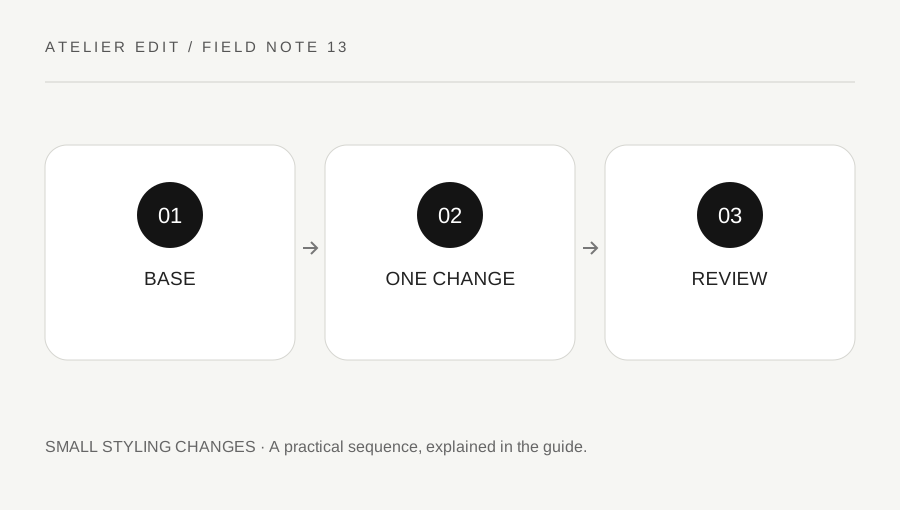
Original explanatory diagram. Examples illustrate a method or decision; they are not claims of personal testing.
Choose a genuinely useful base
Start with an outfit you have worn comfortably in a real setting. Note the actual pieces, footwear and any layer. A combination that only worked for a brief photograph is a less useful base than one that allowed ordinary movement and suited the day.
Write what you liked: easy sleeve movement, a clear colour relationship or a hem that worked with the shoes. Keep the description concrete. Do not label the outfit perfect or assume every other combination must reproduce it exactly.
Select one clear variable
Change only one visible or practical element at first. Compare shoes while keeping the hem and top treatment fixed, or compare a tuck while keeping the footwear unchanged. This makes the effect easier to identify.
If the new piece changes another condition, note that too. A shoe with a different sole height can alter how trousers meet the ground, so the change is not only colour. A heavier layer can affect sleeve comfort. The purpose is honest observation, not a rigid claim that clothing variables can always be isolated completely.
Check real use as well as appearance
Walk, sit and carry the items you normally need. Ask whether the change improves the outfit for its actual setting or simply makes it look different. A new accessory that needs constant adjustment may not be a practical improvement.
Use a short note or optional private photograph to compare versions. Avoid turning the record into a requirement to publish personal images. A written formula can be enough. Keep your own preferences central rather than treating outside approval as the only measure of success.
Keep or discard the change deliberately
For an illustrative trial, repeat straight trousers, a plain knit and familiar shoes, then compare a low-contrast belt with no decorative belt. Choose the version that serves your preference and comfort. Restore the original if the change adds little.
Save the observation with the outfit formula, not a shopping list. A useful result can be confirmation that the original works well. These original editorial suggestions do not promise a trend-driven transformation or require constant novelty. Understanding a dependable combination gives you a clearer basis for future changes and can reduce purchases made to solve a problem you have not identified.
Use a keep, change or restore note
After the comparison, write one of three outcomes: keep the new detail, try it in another setting or restore the original. Add a concrete reason. A shoe change may improve walking comfort but alter trouser clearance; a belt may add a line you like but complicate sitting. Recording both effects is more useful than a simple better or worse score.
If you take private photos, keep the lighting and pose reasonably similar while remembering that an image cannot report comfort. Revisit the note after an actual day of wear where appropriate. Do not rewrite the original observation simply because your preference changes later; a new dated note can show that change honestly. A dependable outfit can remain dependable without constant modification. The experiment is successful when it clarifies a choice, even if the choice is to repeat the original exactly. This makes wardrobe knowledge cumulative instead of treating every day as a requirement to create something entirely new.
A practical checklist
Choices are saved in this browser. Reset them here or clear this site’s browser storage.
Questions that come up
Is repeating an outfit a failure of creativity?
No. Repetition can make comparisons more useful and support a dependable wardrobe. Novelty is optional.
Do I need photographs?
No. A short written formula and observations can be enough. Use private images only if they help you compare.
What if the new version is merely different?
That is useful information. Keep the version that serves your actual preference and day rather than treating every change as an improvement.
References & scope
Background references checked on 18 October 2026. Worked examples and diagrams are original teaching material.